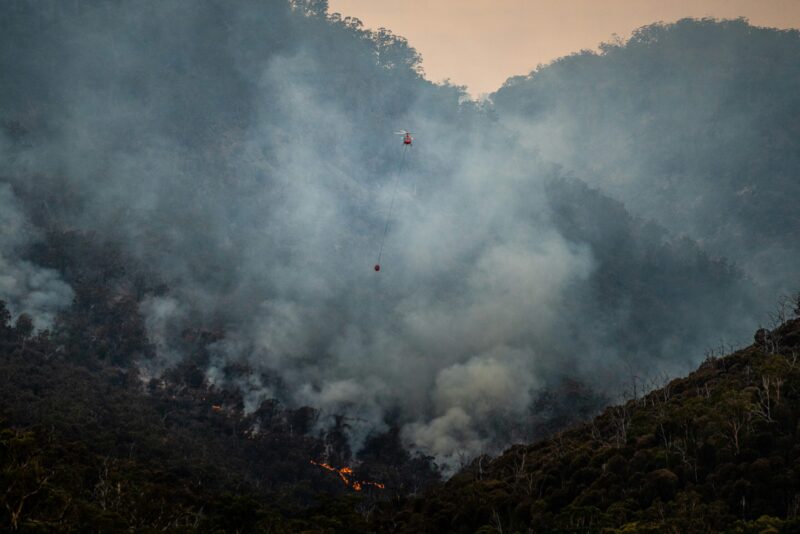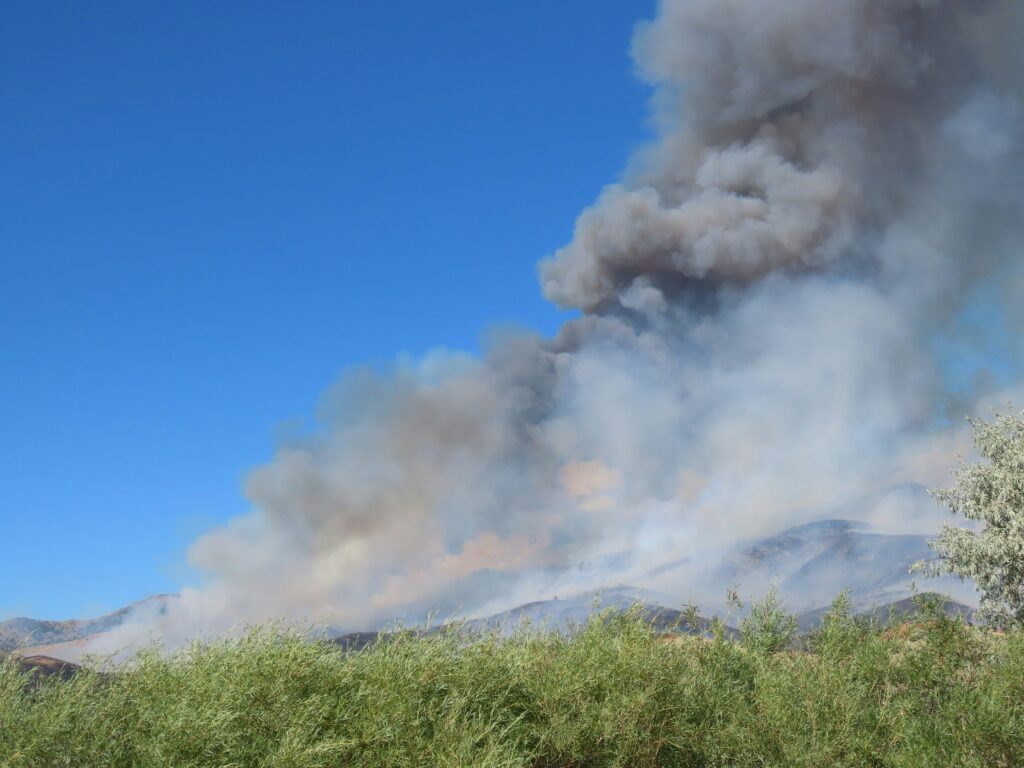
A new study by State of Wildfires Project partner, Sarah Meier and colleagues, examines how wildfire smoke affects bird communities across the contiguous United States. The study, “The impact of wildfire smoke on local avian biodiversity”, published in the Journal of Environmental Economics and Management, finds measurable declines in biodiversity following exposure, even in places where no fire burnt nearby.
They combined 15 years of data (2008 to 2022) from the North American Breeding Bird Survey with high-resolution satellite imagery across roughly 2,800 survey routes. This lets us estimate the effect of wildfire-specific fine-particle pollution (PM2.5) on bird communities, while separating it from the habitat destruction caused by the flames themselves.
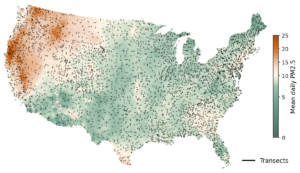
They find that a one-standard-deviation increase in wildfire smoke pollution is associated with a decline of about a tenth of a standard deviation in bird species richness, abundance, and evolutionary diversity in the following breeding season. In the most heavily polluted locations, the declines reach around two standard deviations. Because the study controls for how much land burned, and because the effect persists in areas with no local fire, their results point to smoke pollution, rather than habitat loss, as the driver.
The effects are not uniform across the country. They find them most pronounced in the Eastern Temperate Forests of the eastern US and the North American Deserts of the West, while other regions show greater resilience. This suggests that responses may need to be tailored to local ecosystems.
The losses the authors document are short-term, but they may still matter over the longer run. Temporary disruptions to bird populations can erode ecological resilience, making ecosystems more vulnerable to future shocks. They suggest that biodiversity should be considered alongside the protection of lives, health, and property in fire management decisions, for example when targeting fire suppression or managing vegetation to limit smoke, and that smoke-pollution metrics could be integrated into conservation planning as fire risk increases under a warming climate.
The study is authored by Sarah Meier (Department of Management, Technology and Economics, ETH Zürich) and Eric Strobl (Department of Economics, University of Bern and University of Birmingham). The work was supported by the Dragon Capital Chair on Biodiversity Economics and the Swiss National Science Foundation.
Recent Articles
How Climate Change Is Reshaping the Fire Management Calendar
September 2026

When a wildfire builds a thunderstorm
August 2026