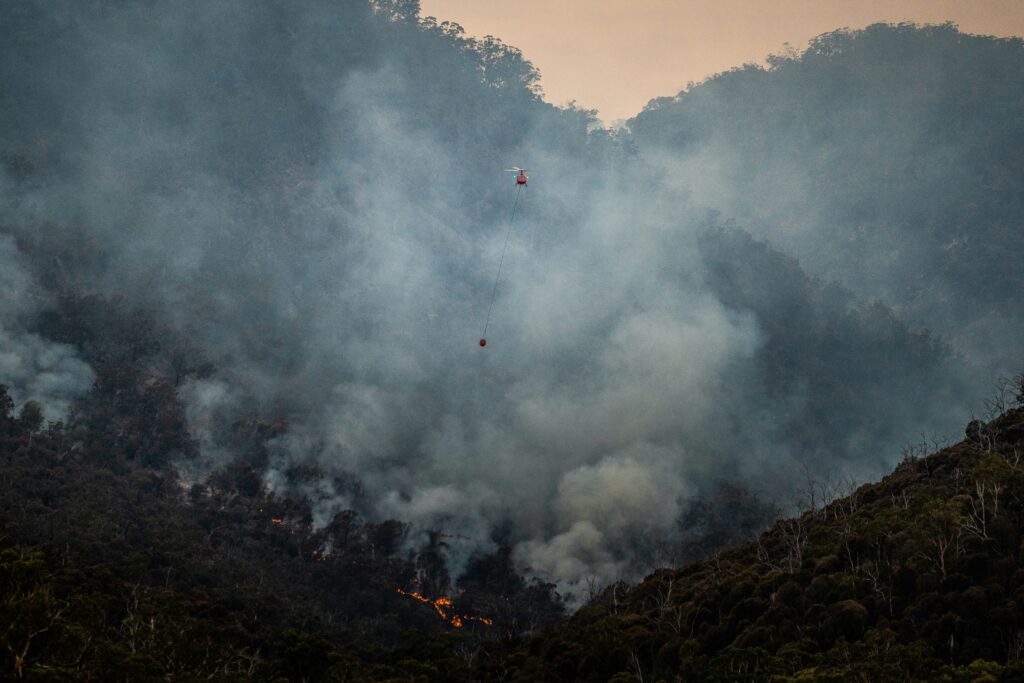
During the first week of July 2026, an intense heatwave affected Spain, Portugal and southern France, creating conditions favourable for widespread wildfire activity. Using the framework developed for the State of Wildfires reports, we assess how antecedent drought, vegetation stress and fuel moisture combined with extreme fire weather to produce elevated wildfire risk across southwestern Europe.
Across much of Spain, daytime temperatures reached 35–41°C, with local maxima of 43°C, while night-time temperatures remained above 20°C and exceeded 25°C in cities such as Madrid. This limited overnight recovery of vegetation and increased cumulative heat stress. At the same time, fire weather conditions became exceptionally favourable for rapid fire spread. Across the Iberian Peninsula, the Fire Weather Index (FWI), which provides a metric of fire prone weather conditions, reached values between 54 and 66, with local maxima approaching 90 in parts of Extremadura, Andalucía, the south-east and north-east coasts, and the Balearic Islands. These values indicate the potential for intense, fast-moving fires which are challenging to suppress. Fine Fuel Moisture Code (FFMC) values ranged between 96 and 98, corresponding to fire danger anomalies above the 96th percentile, which indicated critically dry fine fuels. Furthermore, local wind gusts reached 65 km h⁻¹ in parts of southern and northern Spain, facilitating a rapid wildfire growth following an ignition.
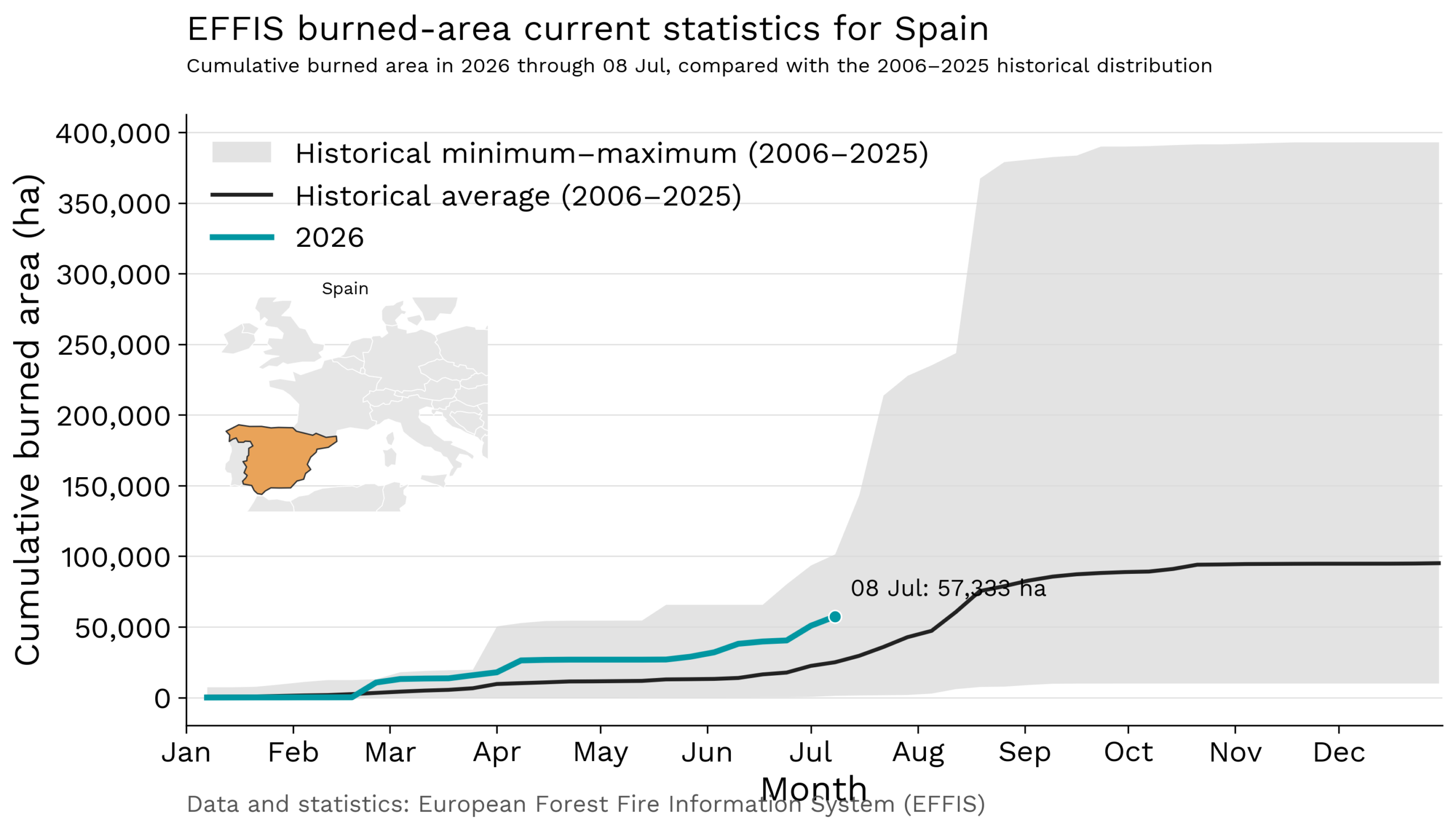
By 8 July, Spain had already recorded approximately 57,000 hectares of burned area according to the European Forest Fire Information System (EFFIS), substantially above the historical average for this stage of the season (Figure 1). Although the cumulative burned area remained within the historical range observed since 2006, the sharp increase in early July is noteworthy because wildfire activity of this magnitude is more typically associated with the latter part of the Mediterranean fire season, when prolonged summer drying has left vegetation at its most combustible. This year, however, the combination of an unusually warm and dry start to summer and the early July heatwave accelerated fuel drying, allowing large-fire activity to intensify several weeks earlier than is normally expected.
The extreme weather conditions explain why fires spread rapidly once ignited, but they do not explain why the landscape was so susceptible to burning. To understand that, it is necessary to examine how environmental conditions evolved during the preceding months.
The hydroclimatic evolution across the Western Mediterranean for the first half of 2026 is shown in Figure 2. Winter was characterised by above-average precipitation, with widespread positive anomalies in both near-surface and deep soil moisture. These wet conditions promoted vigorous vegetation growth across grasslands, shrublands and forest understories, while live fuel moisture remained high and fire danger remained relatively low.
As spring progressed, precipitation declined while temperatures gradually increased. Soil moisture anomalies weakened, live fuel moisture decreased and dead fuels became progressively drier. By early summer, much of the additional vegetation produced during the wet winter and early spring had lost a large fraction of its moisture, while remaining available as combustible biomass.
This sequence illustrates what we refer to as hydroclimatic rebound. Following a wet period, ecosystems respond rapidly through enhanced vegetation growth and fuel accumulation. If this recovery is followed by prolonged drying, the newly produced biomass gradually becomes available to burn. In this way, the landscape retains a hydroclimatic memory of previous months, as rainfall itself does not increase fire danger, but it creates the fuel that can later sustain large wildfires under favourable weather conditions.
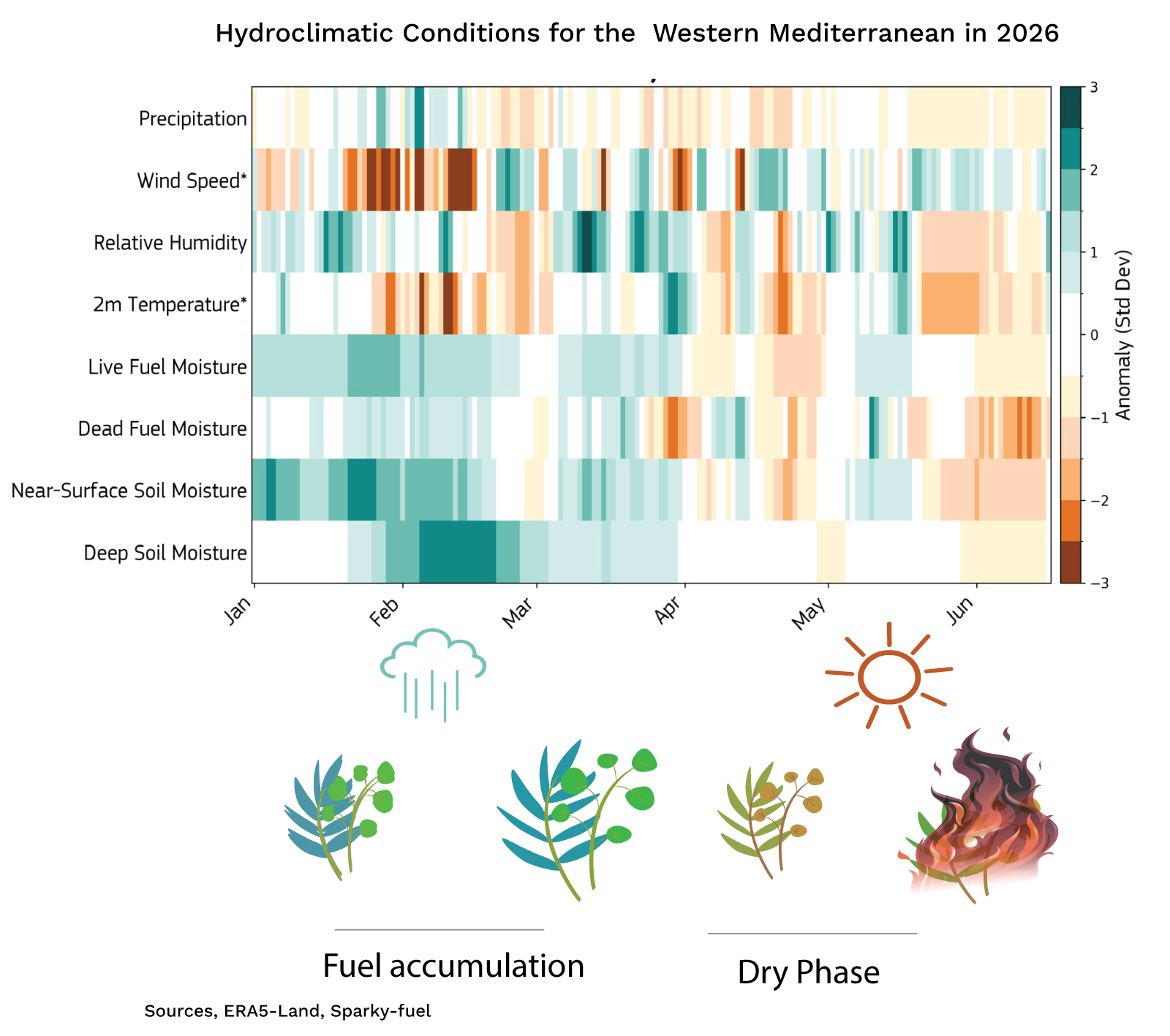
Climate change is expected to increase the frequency and severity of these compound events (Swain et al., 2025). Europe is the fastest-warming continent, warming at approximately twice the global average. Rising temperatures increase atmospheric evaporative demand, accelerate the drying of vegetation following wet periods and lengthen the fire season. Rather than simply producing hotter summers, climate change is increasing the likelihood that periods of enhanced vegetation growth will be followed by rapid drying, creating landscapes with both more fuel and drier fuel. Recent climate projections indicate that under a moderate greenhouse gas emission scenario, large areas of southern Europe could experience up to a tenfold increase in the probability of catastrophic wildfire events, with fire-prone conditions expanding into central and northern Europe as global warming approaches 2°C (El Garroussi et al., 2024). These projections suggest that sequences similar to those observed during the 2026 Spanish wildfire outbreak, wet winters promoting fuel accumulation followed by prolonged drying and extreme fire weather are likely to become increasingly common across Europe. Importantly, this hydroclimatic sequence is not unique to Europe. Similar patterns have been documented across other fuel-limited ecosystems, where anomalously wet periods stimulate vegetation growth before subsequent droughts rapidly cure those fuels, amplifying wildfire risk. In California hydroclimatic rebound has been identified as a key driver of extreme wildfire events (McNorton et al., 2025).
The recent wildfire outbreak in Spain illustrates that wildfire activity is the result of processes operating over very different timescales.
The immediate weather conditions determined when fires spread rapidly, but antecedent hydroclimatic conditions determined how much fuel was available to burn. Understanding this hydroclimatic memory provides a more complete explanation of why some fire seasons become particularly severe and why these compound events are expected to become more frequent in a warming climate.
El Garroussi, S., Di Giuseppe, F., Barnard, C. et al. Europe faces up to tenfold increase in extreme fires in a warming climate. npj Clim Atmos Sci 7, 30 (2024). https://doi.org/10.1038/s41612-024-00575-8
McNorton, J., Moreno, A., Turco, M., Keune, J. and Di Giuseppe, F. (2025), Hydroclimatic Rebound Drives Extreme Fire in California’s Non-Forested Ecosystems. Glob Change Biol, 31: e70481. https://doi.org/10.1111/gcb.70481
Swain, D.L., Prein, A.F., Abatzoglou, J.T. et al. Hydroclimate volatility on a warming Earth. Nat Rev Earth Environ 6, 35–50 (2025). https://doi.org/10.1038/s43017-024-00624-z
Data used in the blog
- European Commission, Joint Research Centre (JRC). European Forest Fire Information System (EFFIS). Copernicus Emergency Management Service.
- Copernicus Climate Change Service (C3S)(2019): ERA5-Land hourly data from 1950 to present. Copernicus Climate Change Service (C3S) Climate Data Store (CDS). DOI: 10.24381/cds.e2161bac
- SPARKY Fuel Dataset,European Centre for Medium-Range Weather Forecasts (ECMWF) (2024): Observation and ERA5-Land derived 9 km global daily fire fuel characteristics since 2003. Cross Data Store (XDS), DOI: 10.24381/378d1497
Recent Articles
A look at Europe’s wildfire season of 2026
October 2026
How Climate Change Is Reshaping the Fire Management Calendar
September 2026
When a wildfire builds a thunderstorm
August 2026