As we move through 2026, scientists are closely monitoring conditions in the tropical Pacific Ocean. While significant uncertainty remains, the possibility of a moderate-to-strong El Niño is already attracting attention because of its well-known influence on droughts, heatwaves, and wildfire activity across many parts of the world. The World Meteorological Organization (WMO) has indicated an 80% likelihood of an El Niño event during June–August 2026, stating that although some uncertainty remains about El Niño peak strength and timing, most forecast models suggest it will be at least moderate – and possibly strong.
Long range predictions always involve uncertainty, particularly during the so-called “spring predictability barrier”—a period during which the evolution of tropical Pacific conditions becomes especially difficult to forecast., However, sea surface temperatures have been rising across the Equatorial Pacific in recent months, and most forecast scenarios suggest a strong warming by the second half of the year. Critical physical signals that often precede El Niño development, such as persistent weakening of the trade winds, may not become evident until the coming months. Nevertheless, even the possibility of a significant El Niño warrants close attention because of its far-reaching impacts on global fire risk.
Why El Niño Matters for Fire
El Niño or El Niño–Southern Oscillation (ENSO), is a natural climate phenomenon in which ocean and atmospheric circulation anomalies interact to influence weather patterns across the globe. By altering atmospheric circulation, temperature and rainfall distribution, ENSO can create conditions that either suppress or promote wildfire activity over vast regions.
While exact precipitation patterns vary with each event, historically, El Niño events have been associated with prolonged droughts across tropical South America, Southeast Asia, and parts of Australia. Reduced rainfall dries vegetation and soils, increasing the availability of combustible fuels and creating favourable conditions for fire ignition and spread. However, ENSO can also influence fire activity through delayed fuel-mediated pathways. In some regions, enhanced rainfall associated with ENSO-driven climate anomalies promotes vegetation growth and fuel accumulation. As this additional biomass subsequently cures and dries, it can increase fire risk months later, meaning that some fire impacts associated with the current ENSO phase may emerge during late 2026 or even persist into the 2027 fire season. Such lagged climate-fire relationships have been documented across multiple ecosystems and are a recognised component of ENSO-driven fire variability.
Recent years provide a powerful reminder of this connection. The strong El Niño of 2023–2024 contributed to exceptional wildfire activity across large parts of the Amazon Basin, with record-breaking fire counts and carbon emissions reported in several regions.
Where Could Fire Risk Increase in 2026?
According to the Fire Weather Index (FWI) forecasts for June 2026 from ECMWF’s System 5 made available by the Copernicus Emergency Management Service,the Amazon Basin emerges as one of the regions of greatest concern.
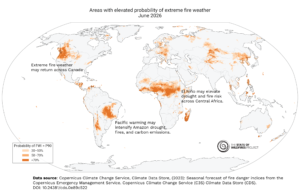
During recent El Niño events in 2023, documented in the first state of wildfire report, prolonged drought conditions have led to widespread fire activity across Brazil, Peru, and Bolivia. Francesca Di Giuseppe explains: “If Pacific warming strengthens during the second half of 2026, parts of western Amazonia could once again experience severe moisture deficits, increasing the vulnerability of some of the world’s most carbon-rich and biodiverse forests.”
Beyond the immediate ecological impacts, fires in these regions release vast quantities of carbon dioxide into the atmosphere, weakening the carbon sink capacity and creating feedbacks that further contribute to global climate change.
Canada is less directly influenced by ENSO than tropical regions, yet recent years have demonstrated how vulnerable northern forests can be to persistent heat and drought. Dr Chantelle Burton notes: “The sequence of record-breaking fire seasons in Canada highlighted how extensive fire-conducive weather can overwhelm even well-resourced fire suppression systems. Seasonal forecasts from Copernicus currently suggest the possibility of above-average fire weather conditions across parts of Canada in June 2026, although significant uncertainty remains regarding the extent and severity of any impacts.”
Other regions may emerge as areas of concern later in the season. Indonesia has long been one of the regions most sensitive to ENSO-related drought. During El Niño years, rainfall deficits can become particularly severe across the peatland landscapes of Sumatra and Kalimantan. Once ignited, peat fires can burn for extended periods, producing dense smoke and substantial carbon emissions.
Di Giuseppe notes: “Climate will influence the risk, but it will not determine the outcome. Strong land-use management and effective restrictions on agricultural burning could significantly reduce fire impacts in Indonesia, even if drought conditions intensify during 2026. We have already seen this in recent El Niño years, where improved fire management and policy measures helped prevent the extreme fire seasons that many had anticipated.”
Uncertainty Remains
Dr Di Giuseppe and Dr Burton emphasise that, despite significant advances in seasonal forecasting, forecasts should not be interpreted as predictions of certainty.
“Climate models provide a range of plausible futures rather than a single deterministic outcome. While most forecast scenarios currently indicate the development of a strong El Niño event by late 2026, some suggest a weaker event or even a neutral state. Local weather variability, atmospheric circulation changes, and other climate interactions can all influence the eventual outcome” they clarify.
The coming months will reveal whether the Pacific is indeed moving toward a significant El Niño event. Regardless of what unfolds, the ability to identify periods of elevated wildfire risk months in advance remains one of the most powerful tools available for reducing future impacts and improving preparedness.
Methods
We analysed the probability for the fire weather index (FWI) to be in the top 10% of its climatological value.The FWI is a globally used measure of wildfire danger that combines temperature, humidity, wind speed, and rainfall to estimate how easily fires can ignite and spread. Developed in Canada and now used by fire management agencies worldwide, it provides a simple way to monitor and forecast fire-conducive weather conditions.
The FWI is designed to quantify landscape flammability rather than drought severity and is particularly sensitive to temperature and atmospheric conditions. As a result, regions experiencing severe drought may not necessarily exhibit the largest FWI anomalies, while areas affected by strong temperature anomalies can show elevated fire danger despite relatively modest precipitation deficits. This fundamental distinction explains why seasonal FWI forecasts do not always coincide with drought indicators and should therefore be interpreted with caution when assessing drought impacts or comparing fire danger with drought severity.
Recent Articles
A look at Europe’s wildfire season of 2026
October 2026
How Climate Change Is Reshaping the Fire Management Calendar
September 2026
When a wildfire builds a thunderstorm
August 2026