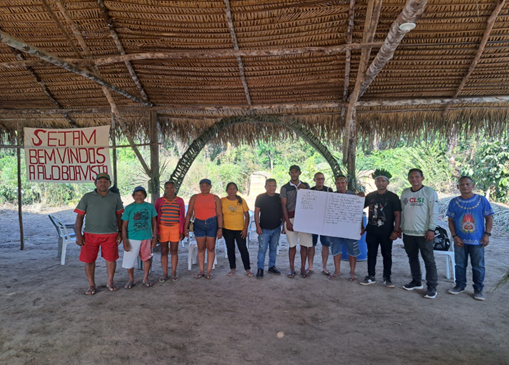
State of Wildfires project co-lead gives his views on how wildfire-related policy discussions played out at COP30.
As a fire scientist working on tropical forests, COP30 was both inspiring and uncomfortable. A reminder of why wildfire attribution science matters, but also of who we’ve been overlooking.
Attribution science – the study of how climate change and other drivers influence extreme events such as wildfires- has become central to global policy debates. It quantifies risk, guides negotiations, and is increasingly shaping climate finance. But whilst in Belém, it became clear that those numbers alone cannot capture the reality of people living with climate-driven fire.
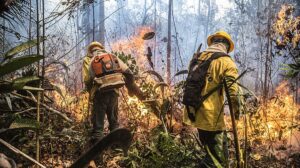
Indigenous leaders, volunteer firefighters, and local organisations brought perspectives that rarely make it into negotiation halls. People like Tainan Kumaruara from COIAB described how fires are reshaping the Amazon: eroding biodiversity, drying rivers and springs, disrupting farming seasons, and threatening food security. Tainan, and many others dealing with climate-induced fires across Brazil, also spoke about something that never appears in technical reports: the cultural loss, the erosion of knowledge, traditions and spiritual meaning tied to fire as a tool of care rather than destruction. And hearing this made it even clearer that our science, which often treats fire only as an ecological process or a hazard, risks missing what fire means to people and, therefore, what support they actually need.
What struck me most throughout the week was how clearly local and Indigenous communities described the pressures they face: climate-driven wildfire change, harmful land-use incentives, and the expectation that they should be both the frontline responders and the long-term solution to our emerging wildfire crisis. All this despite contributing almost nothing to the drivers of the crisis, and despite often tackling it with minimal financial or logistical support, especially from those of us who, historically, are the most responsible for their lived climate crisis. Some of it was hard to hear- there was a lot of well-founded (but respectful) anger about how fires are affecting people on the front line, but also an undertone of how our science isn’t helping either. Or at least not as much as it could.
I kept thinking, we spend so much of our attribution science chasing big numbers for international policy, without fully recognising how difficult it is for local people to get even basic support. There must be better ways we can adapt our science to meet the needs of, and maybe even empower, people living with wildfires. And not just cater to the needs of our media and perceived international negotiators.
When I asked about this, many (again very respectfully) pointed out how mistrust can grow when scientists insist on “testing” knowledge that communities have built over generations. But at least we were in the room. There was a lot of justified frustration about how few high-level policymakers show up to hear these frontline perspectives.
The positive part: the need for evidence to support communities, often through Integrated Fire Management, came up again and again. But it was paired with a clear message: scientists aren’t helping as much as we think we are. Still, there was real optimism that attribution science can help, as long as we build trust, work with respect, and co-develop the knowledge needed by the people living through the wildfire crisis every year.
All of this left me thinking that attribution science needs a shift. Not in rigour, but in purpose. Something I’m very aware that I’m far from the first to realise. Many people in those rooms in Belém have been saying these things for years, while I’m only now starting to catch up.
What became clear to me is that attribution can’t stop at estimating “how much climate change increased the risk.” It also needs to help make sense of what kind of fire communities are facing, especially in places where not all fire is inherently bad. As well as an important ecological process, fire can also be a livelihood tool and an important cultural practice. A process that has evolved alongside local ecology and local people. What many communities are now confronting, though, is something different: climate-driven extremes bringing new types of extreme fire layered onto harmful land-use incentives.
If attribution is to be genuinely useful in these contexts, it needs to support people in understanding what is being lost, what could still be protected, and which strategies might actually build resilience. That likely means co-developing questions and models with the people who live with fire, treating cultural and ecological knowledge as evidence rather than something to be “validated,” and exploring how attribution frameworks could inform integrated fire management and adaptation planning on the ground.
These are vague early reflections from someone still catching up to ideas many others have carried for years, shaped by the people at COP30 who have been thinking about this far longer than I have. But they made something impossible to ignore: attribution science can’t stay where it is. It has a much bigger and meaningful role to play if we choose to let it. And at the very least, the way we approach attribution science at UKCEH will change.
State of Wildfires activities at COP30
Beyond negotiations, COP30 in Belém provided an important space for scientists, Indigenous leaders, NGOs, policymakers, and practitioners to share knowledge and practical solutions. The State of Wildfires team contributed to this wider work, including through two wildfire-focused events, designed to bring evidence, lived experience and policy needs into the same conversation. Our events where co-organised with SOS Pantanal and the BASE Initiative wildfire program
Our COP30 wildfire events:
- UK Pavilion: Wildfires: Science, Stories, and Strategies for Resilience in Amazonia. Brought together scientists, Indigenous leaders and civil society organisations to discuss how climate-driven wildfire change is reshaping Amazonia; highlighted the need for community-adapted Integrated Fire Management; and shared lived experiences from frontline fire practitioners.
- UNFCCC Side Event – Building Resilience through Integrated Fire Management. Explored how evidence, early-warning systems, and attribution science can support communities facing increasing wildfire risk. The panel discussed policy needs, barriers to support, and the importance of working alongside cultural and ecological knowledge.
Recent Articles
Build your own probability of fire models
February 2026
How 2025 Became the UK’s Record-Breaking Wildfire Year
February 2026